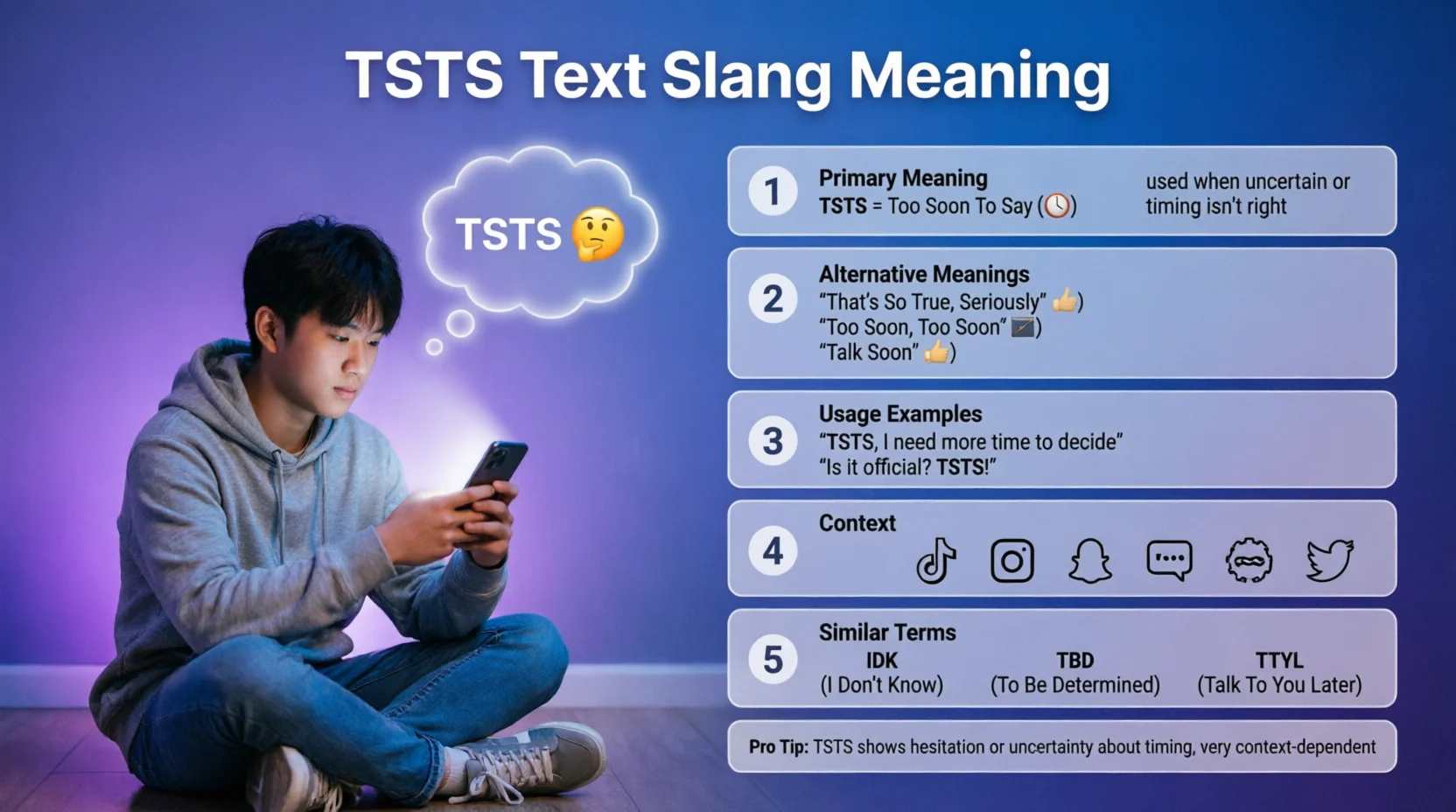
If you’ve ever been scrolling through messages or social media and suddenly came across “tsts,” you’re not alone in feeling confused. Internet slang evolves fast, and new abbreviations pop up all the time. Some are easy to guess, while others—like “tsts”—can leave you scratching your head.
So, what does “tsts” actually mean in text?
Let’s break it down in a simple, clear, and human way so you can understand it, use it correctly, and never feel out of place in online conversations again.
What Does “TSTS” Mean in Text?
“TSTS” is an informal expression that usually represents a sound rather than a full phrase. It mimics the clicking or disapproving sound people make with their tongue, similar to saying:
- “tsk tsk”
- “tut tut”
In texting, “tsts” is often used to show:
- Mild disappointment
- Disapproval
- Playful judgment
- Teasing reaction
Think of it as a way to express emotion without typing a full sentence.
The Real Meaning Behind “TSTS”
Unlike many abbreviations that stand for words (like “LOL” or “BRB”), “tsts” is more about tone and feeling.
When someone types “tsts,” they’re usually reacting to something you said or did. It can mean:
- “That’s not good.”
- “You should know better.”
- “I’m judging you… but lightly.”
- “Wow, really?”
The meaning depends heavily on context and the relationship between the people talking.
Where Did “TSTS” Come From?
“TSTS” comes from the real-life tongue-clicking sound people make when they’re disappointed or slightly annoyed.
In many cultures, this sound is common in everyday conversation. Over time, people started writing it as:
- “tsk”
- “tsk tsk”
- and eventually “tsts”
As texting became more casual and expressive, “tsts” became a quick way to capture that exact reaction in written form.
How “TSTS” Is Used in Text Conversations
Let’s look at how people actually use “tsts” in real messages.
1. Showing Mild Disapproval
Example:
“You forgot your assignment again?”
“tsts…”
Here, it shows disappointment—but not in a harsh way.
2. Playful Teasing
Example:
“I ate your chocolate 😅”
“tsts, I trusted you”
This is more joking than serious.
3. Reacting to Bad Decisions
Example:
“I stayed up all night gaming”
“tsts, that’s why you’re tired now”
It implies: “You brought this on yourself.”
4. Expressing Sarcasm
Example:
“I totally didn’t skip class…”
“tsts sure you didn’t”
Here, it adds a sarcastic tone.
Is “TSTS” Positive or Negative?
“TSTS” is usually slightly negative, but not aggressively so.
It sits somewhere in the middle:
- Not angry
- Not rude
- Not completely serious
Instead, it’s more like a soft, expressive reaction.
In many cases, it’s actually friendly—especially when used between friends.
“TSTS” vs “TSK TSK” – What’s the Difference?
You might be wondering how “tsts” compares to “tsk tsk.”
Here’s the difference:
- “tsk tsk” → More traditional, more recognizable
- “tsts” → Shorter, more modern, more casual
Both mean almost the same thing, but “tsts” feels more like internet slang, while “tsk tsk” feels more like written English.
When Should You Use “TSTS”?
You can use “tsts” in casual conversations when:
- You want to react quickly
- You’re teasing someone
- You’re expressing light disappointment
- You want to sound playful instead of serious
Good Situations
- Chatting with friends
- Social media comments
- Casual texting
Avoid Using It When
- Talking to your boss
- Writing formal emails
- Communicating in serious situations
Because “tsts” is informal, it may come across as unprofessional in formal settings.
How Tone Changes the Meaning of “TSTS”
Tone is everything.
The same “tsts” can mean different things depending on how it’s used.
Friendly Tone
“tsts 😂 you always do this”
→ Light teasing
Serious Tone
“tsts. That wasn’t okay.”
→ More serious disapproval
Sarcastic Tone
“tsts, sure you didn’t lie 🙄”
→ Playful sarcasm
So, always consider the context and emojis used alongside it.
Common Variations of “TSTS”
You might see different versions of “tsts” online. These include:
- tsk
- tsk tsk
- tss
- tch tch
All of these represent similar sounds and emotions, though their usage may vary slightly depending on culture or platform.
Is “TSTS” Popular on Social Media?
Yes, but it’s not as mainstream as some slang terms.
You’ll mostly see it on:
- Messaging apps
- Comment sections
- Casual online chats
It’s especially common in informal, expressive conversations, where people want to show emotion without typing long sentences.
Why People Use “TSTS” Instead of Words
There’s a simple reason: it feels more human.
Typing “I’m disappointed in you” sounds serious.
Typing “tsts” feels:
- Short
- Emotional
- Natural
- Less confrontational
It’s similar to how people use:
- “hmm”
- “ugh”
- “meh”
These are all reaction-based expressions, not full sentences.
Misunderstandings Around “TSTS”
Because it’s not very common, some people misunderstand “tsts.”
Common Confusions
- Thinking it’s an acronym
- Assuming it stands for a phrase
- Not recognizing it as a sound
If someone doesn’t know it, they might ask what it means—or just ignore it.
Should You Start Using “TSTS”?
You can—but use it wisely.
Use It If:
- You enjoy casual texting
- You want to sound expressive
- You’re talking with people who understand slang
Avoid It If:
- You’re unsure how it’ll be received
- The conversation is serious
- The other person might not understand it
Like all slang, it works best when both people are on the same page.
Final Thoughts: Understanding “TSTS” in Text
“TSTS” might look confusing at first, but it’s actually simple once you get it.
It’s not an acronym.
It’s not a secret code.
It’s just a text version of a real-life sound—a quick way to show mild disapproval, teasing, or playful judgment.
In today’s fast-moving digital world, expressions like “tsts” help people communicate emotions quickly and naturally. And once you understand it, you’ll start noticing it more often—and maybe even using it yourself.
descover more post
What Does LOML Mean in Text Real Meaning Examples …
What Does BTS Mean in Text Real Meaning Examples 2026
What Does Opt Mean in Text Real Meaning Examples 2026

Ayesha Khan is a dedicated content writer and digital creator at Meizano, passionate about creating clear, helpful, and user-focused content. She specializes in writing easy-to-understand articles that provide real value to readers while following modern SEO and digital content standards. Known for her hardworking mindset, creativity, and attention to detail, Ayesha focuses on delivering high-quality content that helps users find accurate information quickly and easily. She believes in continuous learning, consistency, and building trust through informative and engaging online content.