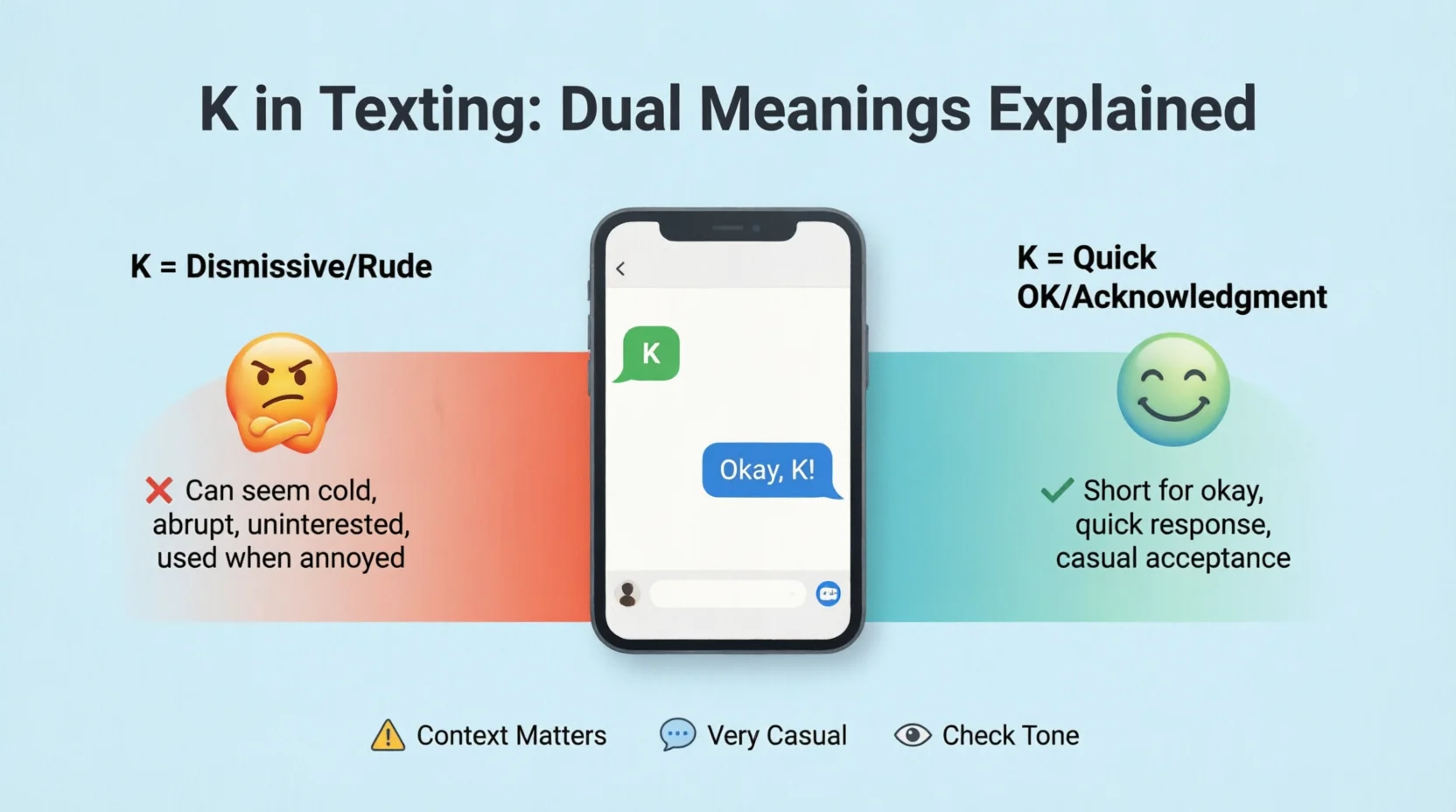
If you’ve ever received a simple “k” in a text message, you probably paused for a second and thought… wait, what does that mean? Is the person annoyed? Are they just busy? Or is it completely neutral?
Welcome to the confusing world of internet slang, where even a single letter can carry different meanings depending on context, tone, and relationship.
In this guide, we’ll break down the real meaning of “k” in text, how people use it in 2026, and what it actually feels like when someone sends it. We’ll also go through examples so you can understand it clearly and avoid misunderstandings.
What Does “K” Mean in Text?
At its simplest, “k” is a shortened version of “okay.”
That’s it.
It’s often used as a quick reply to:
- Confirm something
- Acknowledge a message
- Show agreement (sometimes)
But here’s the important part:
“k” is not always neutral. The tone can change depending on how and when it’s used.
Why Do People Use “K” Instead of “Okay”?
People use “k” mainly for convenience.
Typing one letter is faster than typing “okay,” especially when:
- You’re busy
- You’re multitasking
- You don’t want to continue the conversation
In fast messaging environments like WhatsApp, Instagram, and Snapchat, short replies are common.
But while it saves time, it can also create confusion.
The Hidden Tone Behind “K”
Here’s where things get interesting.
Even though “k” literally means “okay,” it can feel very different emotionally.
Depending on the situation, “k” can come across as:
- Neutral → simple acknowledgment
- Cold → lack of interest
- Annoyed → subtle frustration
- Dismissive → ending the conversation
That’s why people sometimes overthink it.
“K” vs “Okay” vs “Ok” vs “KK”
These small variations matter more than you might think.
1. “K”
- Shortest form
- Can feel dry or blunt
- Often seen as slightly rude in emotional conversations
2. “Ok”
- More neutral
- Still short, but less harsh than “k”
3. “Okay”
- Full word
- Friendly and clear
- Safest option in most situations
4. “KK”
- More casual and friendly
- Often used in gaming or informal chats
- Shows a bit more energy than “k”
When “K” Is Totally Normal
Let’s not overthink it too much — sometimes “k” is just… “k.”
Here are situations where it’s perfectly fine:
✔ Quick confirmations
“Meeting at 5?”
“k”
✔ Busy replies
“I sent the file”
“k”
✔ Ongoing conversations
If you’re already chatting casually, “k” may not feel rude at all.
When “K” Might Feel Rude
Now let’s talk about the situations where “k” can cause problems.
❌ Emotional conversations
If someone shares something serious:
“I’m really stressed today”
“k”
This can feel dismissive or uncaring.
❌ Arguments or disagreements
During tension:
“You never listen to me”
“k”
Here, it often means:
- “I’m done talking”
- “Whatever”
- “I don’t care anymore”
❌ When a longer reply is expected
If someone asks something important:
“Can you help me with this?”
“k”
It may feel like you’re avoiding the conversation.
Real Examples of “K” in Text
Let’s look at real-life style examples so you can understand better.
Example 1: Neutral Use
A: “I’ll call you later”
B: “k”
Meaning: Got it, no issue.
Example 2: Slightly Cold
A: “Why didn’t you reply?”
B: “k”
Meaning: Possibly annoyed or uninterested.
Example 3: Ending a Conversation
A: “We need to talk”
B: “k”
Meaning: Acknowledged, but not engaging.
Example 4: Friendly Context
A: “Game at 9?”
B: “kk”
Meaning: Yes, sounds good.
How “K” Is Used on Social Media (2026)
In 2026, communication is faster than ever. Short replies dominate.
Here’s how “k” fits into modern platforms:
📱 Messaging Apps
On WhatsApp or Messenger:
- Used for quick replies
- Often appears when someone is multitasking
📸 Instagram & Snapchat
- Less common in comments
- More common in DMs
- Sometimes used to end chats quickly
🎮 Gaming Chats
- “k” or “kk” is very common
- Used to confirm instructions or plans
💬 Group Chats
- Often used when many messages are coming in fast
- Helps keep replies short
Is “K” Rude? The Honest Answer
It depends on context.
Here’s a simple way to think about it:
| Situation | Meaning of “k” |
|---|---|
| Casual chat | Neutral |
| Busy moment | Acceptable |
| Serious talk | Rude |
| Argument | Dismissive |
So no — “k” is not always rude.
But yes — it can feel rude depending on the situation.
Why People Overthink “K”
You’re not alone if you’ve ever stared at a “k” and wondered what it really means.
This happens because:
- Text has no tone of voice
- No facial expressions
- No body language
So your brain fills in the blanks.
And often… it assumes the worst.
How to Respond to “K”
If someone sends you “k,” what should you do?
Option 1: Don’t overreact
Sometimes it really just means “okay.”
Option 2: Ask for clarity
If it feels off:
“Everything okay?”
Option 3: Continue normally
“Cool, see you later”
Option 4: Mirror the tone
If the conversation is casual, replying shortly is fine too.
Should You Use “K”?
Here’s a practical guideline.
Use “k” when:
- You’re in a hurry
- The conversation is casual
- No emotions are involved
Avoid “k” when:
- Someone is sharing feelings
- You’re having an important discussion
- You want to sound polite or warm
Better Alternatives to “K”
If you want to avoid misunderstandings, try these instead:
- “Okay 👍”
- “Got it”
- “Sounds good”
- “Alright”
- “Sure”
These feel more human and friendly.
Cultural Differences in “K”
Interestingly, how “k” is perceived can vary.
In some regions:
- It’s completely normal and not rude at all
In others:
- It’s seen as cold or passive-aggressive
That’s why context and relationship matter more than the word itself.
The Psychology Behind Short Replies
Short replies like “k” can signal different things:
- Efficiency → saving time
- Disinterest → low engagement
- Emotional distance → avoiding deeper talk
But again, it’s not always intentional.
Sometimes people just… type fast and move on.
Common Misunderstandings About “K”
Let’s clear up a few myths.
Myth 1: “K always means anger”
Not true. It can be completely neutral.
Myth 2: “K ends friendships”
Definitely not. It’s just a texting habit.
Myth 3: “K is always rude”
Only in certain contexts.
Final Thoughts
The meaning of “k” in text is simple on the surface but surprisingly complex in real conversations.
At its core, it just means “okay.”
But tone, timing, and context can completely change how it feels.
If you remember one thing, let it be this:
Don’t judge the message — understand the situation.
And when in doubt, it’s always better to use a slightly longer, friendlier reply.
descover more post
What Does WSGG Mean in Text Real Meaning Examples …
What Does OC Mean in Text Real Meaning Examples 2026
What Does YWA Mean in Text Real Meaning Examples 2026

Areeba Shah is a dedicated content writer and digital creator at Meizano, passionate about creating helpful, accurate, and easy-to-understand content for online readers. She focuses on delivering user-friendly articles that provide real value, solve everyday questions, and improve the reader’s experience. With a strong commitment to quality, consistency, and continuous learning, Areeba believes in producing engaging content that is both informative and trustworthy.