
If you’ve spent any time texting, scrolling social media, or chatting online, you’ve probably seen the short abbreviation “TF” pop up. Maybe someone replied to your message with “what tf?” or you saw it in a meme and wondered what it actually means.
You’re not alone—this tiny two-letter slang term can be confusing at first. The meaning of “TF” depends on context, tone, and even the platform where it’s used. But once you understand it, you’ll start noticing it everywhere.
In this guide, we’ll break down what “TF” means in text, how people use it, where it comes from, and how you can use (or avoid) it correctly in your own conversations.
What Does “TF” Mean in Text?
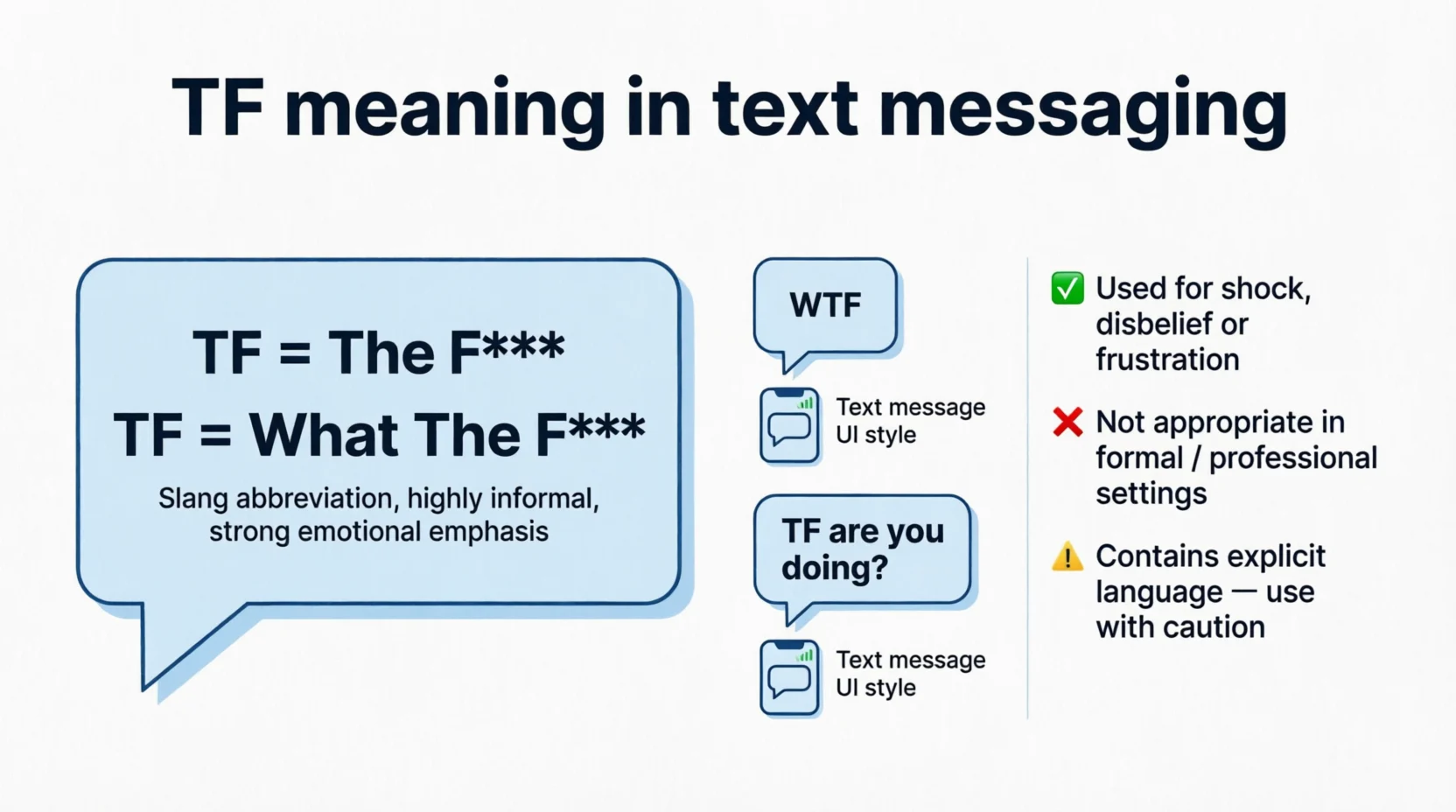
At its core, “TF” stands for “the f*”**.
Yes—it’s a shortened, less explicit version of a phrase that includes a swear word. People use it to express:
- Surprise
- Confusion
- Frustration
- Strong emotion
For example:
- “What tf is going on?”
- “Why tf did you do that?”
- “How tf did this happen?”
In these sentences, “TF” adds intensity. Without it, the sentence would still make sense—but it would feel less emotional.
Why Do People Use “TF” Instead of Writing the Full Phrase?
There are a few reasons why “TF” became popular:
1. It’s Faster to Type
In texting and online chats, people prefer short forms. “TF” saves time and effort.
2. It Softens the Swear Word
Writing the full phrase can feel too harsh or inappropriate in some situations. “TF” makes it slightly less aggressive.
3. It Fits Internet Culture
Online communication often uses abbreviations like:
- LOL (laugh out loud)
- OMG (oh my God)
- IDK (I don’t know)
“TF” fits right into that style.
Different Ways “TF” Is Used in Conversations
Even though “TF” has one main meaning, it can be used in different ways depending on the situation.
1. To Express Confusion
This is one of the most common uses.
Example:
- “What tf are you talking about?”
- “Where tf did my phone go?”
Here, the person is confused and possibly annoyed.
2. To Show Surprise or Shock
Sometimes people use “TF” when something unexpected happens.
Example:
- “How tf did you finish that so fast?”
- “What tf?! That came out of nowhere.”
In this case, it adds a strong emotional reaction.
3. To Show Anger or Frustration
“TF” can also make a sentence sound more intense or aggressive.
Example:
- “Why tf would you say that?”
- “Who tf took my charger?”
Here, the tone is clearly frustrated or upset.
4. For Emphasis in Casual Speech
Sometimes it’s not even about anger—it’s just emphasis.
Example:
- “This is so tf weird.”
- “That movie was tf amazing.”
In these cases, “TF” is used almost like an intensifier, similar to saying “very” or “extremely,” but with a stronger tone.
Is “TF” Always Offensive?
Not always—but it can be.
Since it comes from a phrase that includes a swear word, it carries a certain tone. Whether it feels offensive depends on:
- The relationship between people
- The situation
- The platform (formal vs casual)
When It’s Usually Okay:
- Chatting with friends
- Casual texting
- Social media comments
- Memes and jokes
When You Should Avoid It:
- Professional emails
- Work conversations
- Talking to teachers or elders
- Formal writing
If you’re unsure, it’s safer not to use it.
“TF” in Social Media and Memes
“TF” is extremely common on platforms like:
- Twitter (X)
- TikTok
- Snapchat
You’ll often see it in memes or reactions because it quickly conveys emotion.
Examples from social media style:
- “Me opening my exam paper: what tf is this 😭”
- “When your phone dies at 2%: why tf now??”
- “That plot twist had me like WHAT TF”
In these contexts, “TF” helps exaggerate feelings for humor or relatability.
Common Variations of “TF”
People don’t always use “TF” the same way. Here are some common variations:
1. “WTF”
This is the full abbreviation of “what the f***”.
Example:
- “WTF is happening?”
It’s stronger and more direct than just “TF”.
2. “How TF”
Used when something seems impossible or surprising.
Example:
- “How tf did you solve that?”
3. “Why TF”
Used for frustration or questioning someone’s actions.
Example:
- “Why tf would you do that?”
4. “Who TF”
Used when someone is shocked or annoyed about a person.
Example:
- “Who tf is calling me at 3 AM?”
Tone Matters More Than You Think
One important thing to understand is that “TF” doesn’t have a fixed tone. It depends heavily on how it’s used.
Friendly Tone:
- “How tf are you so good at this 😂”
Angry Tone:
- “What tf is wrong with you?”
Same words, completely different feelings.
That’s why context is everything.
Should You Use “TF” in Your Own Texts?
It depends on your communication style and audience.
You can use it if:
- You’re talking to close friends
- You’re being casual or funny
- The conversation is informal
You should avoid it if:
- You want to sound polite or professional
- You don’t know the person well
- The topic is serious
A good rule: if you wouldn’t say the full phrase out loud, you probably shouldn’t use “TF” either.
Alternatives to “TF” (Cleaner Options)
If you want to express the same feeling without sounding rude, here are some alternatives:
Instead of:
- “What tf is this?”
Try:
- “What is this?”
- “What’s going on?”
- “I don’t understand this.”
Instead of:
- “Why tf did you do that?”
Try:
- “Why did you do that?”
- “Can you explain why you did that?”
These sound more polite and are better for formal situations.
How “TF” Became Popular
Internet slang evolves quickly, and “TF” is a great example of that.
It likely became popular because:
- People wanted a shorter version of “WTF”
- Texting culture encouraged abbreviations
- Social media amplified casual language
Over time, it spread across platforms and became part of everyday online language.
Today, even people who don’t use a lot of slang may recognize it.
Common Mistakes People Make With “TF”
Even though it’s simple, people sometimes misuse it.
1. Using It in Formal Writing
Avoid using “TF” in essays, emails, or professional content.
2. Overusing It
Using “TF” in every sentence can make your messages sound aggressive or immature.
3. Misreading Tone
Someone might use “TF” jokingly, but it can come across as rude if you don’t know them well.
Real-Life Examples of “TF” in Conversations
Let’s look at some realistic text conversations:
Example 1: Confusion
Friend 1: “I just saw him with someone else.”
Friend 2: “Wait, what tf??”
Example 2: Humor
Person A: “I ate the whole pizza alone.”
Person B: “How tf 😂”
Example 3: Frustration
Person A: “I forgot my keys again.”
Person B: “Why tf do you always do that?”
These examples show how flexible the phrase can be.
Is “TF” Still Popular in 2026?
Yes—“TF” is still widely used in 2026.
Even though new slang appears every year, some expressions stick around because they’re:
- Easy to use
- Emotionally expressive
- Universally understood
“TF” falls into that category, so it’s not going away anytime soon.
Final Thoughts
So, what does “TF” mean in text?
Simply put, it’s a short form of “the f***” used to express strong emotions like confusion, surprise, or frustration. It’s a common part of internet slang and shows up in texts, memes, and social media posts all the time.
But like many slang terms, it comes with a bit of attitude. It can sound funny and relatable in the right context—or rude and aggressive in the wrong one.
If you understand when and how to use it, “TF” can be a useful way to add emotion to your messages. Just remember to match your tone to your audience.
descover more post
What Does LMFAO Mean in Text Real Meaning Examples …
What Does DTF Mean in Text Real Meaning Examples 2026
What Does FN Mean in Text Real Meaning Examples 2026

Areeba Shah is a dedicated content writer and digital creator at Meizano, passionate about creating helpful, accurate, and easy-to-understand content for online readers. She focuses on delivering user-friendly articles that provide real value, solve everyday questions, and improve the reader’s experience. With a strong commitment to quality, consistency, and continuous learning, Areeba believes in producing engaging content that is both informative and trustworthy.