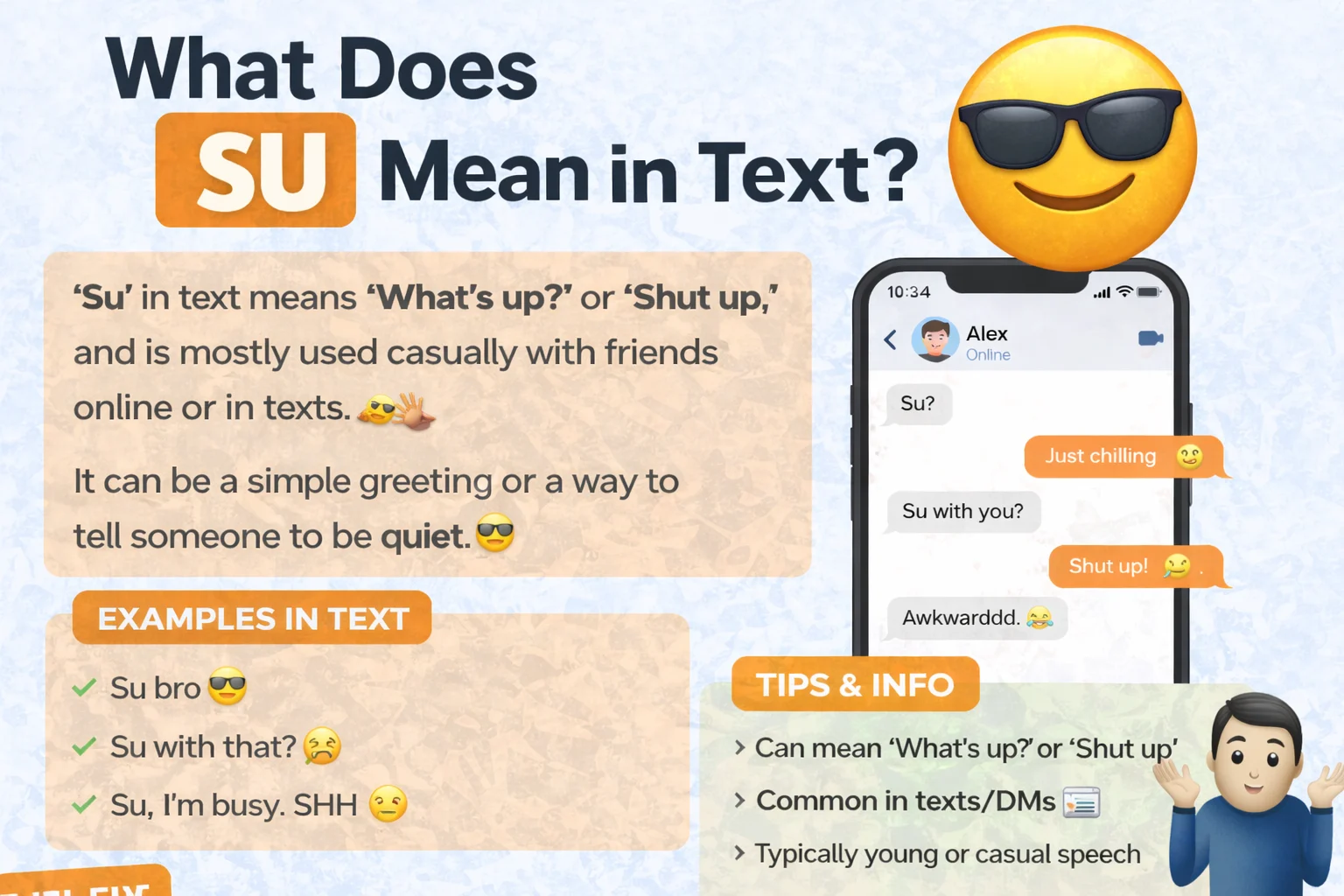
If you’ve ever received a message that simply says “su” and felt confused, you’re definitely not alone. Internet slang changes fast, and short abbreviations like this can have multiple meanings depending on the context.
In this guide, we’ll break down what “su” means in text messages, social media, and online chats. You’ll learn how it’s used, when to use it, and how to understand it correctly so you don’t feel lost in conversations.
Let’s keep it simple and clear.
What Does “Su” Mean in Text?
The meaning of “su” depends on the situation, but the most common definition is:
👉 “What’s up?” (short form)
People use “su” as a quick, casual way to start a conversation. It’s basically the same as saying:
- What’s up?
- What are you doing?
- How are things?
It’s informal and usually used between friends or people who are comfortable with each other.
Why Do People Use “Su”?
Short answer: speed and convenience.
Online communication is all about being fast and effortless. Instead of typing full sentences, people shorten words to save time.
“Su” is just another example of that trend, like:
- “wyd” → what are you doing
- “brb” → be right back
- “idk” → I don’t know
It’s especially common on:
- Snapchat
- Instagram DMs
- Text messages
- Gaming chats
Different Meanings of “Su” (Based on Context)
Even though “what’s up” is the most common meaning, “su” can mean different things depending on how it’s used.
Let’s go through the main ones.
1. “What’s Up?” (Most Common)
This is the meaning you’ll see most often.
Example:
- Person A: “su”
- Person B: “not much, just chilling. you?”
Here, “su” is just a greeting.
2. “Swipe Up” (Social Media Meaning)
On platforms like Instagram or Snapchat, “su” can also mean:
👉 Swipe Up
This is often used in stories.
Example:
- “New video just dropped 🔥 su to watch!”
In this case, the person is asking you to swipe up on their story to see something.
3. “Shut Up” (Less Common)
Sometimes, “su” can mean:
👉 Shut up
But this depends heavily on tone and context.
Example:
- “su bro 😂 you’re joking”
This version is usually playful, not serious. If someone says it aggressively, the tone will make that clear.
4. “See You” (Rare)
In some cases, “su” might stand for:
👉 See you
This is less common, but you might still come across it.
Example:
- “ok su later”
How to Know Which Meaning Is Correct
This is where context becomes important.
Ask yourself:
- Is it the start of a conversation? → probably “what’s up”
- Is it on a story or post? → likely “swipe up”
- Is it part of a joke or argument? → could mean “shut up”
Let’s look at a few quick examples:
Example 1:
- “su bro”
👉 Meaning: What’s up
Example 2:
- “su for full video”
👉 Meaning: Swipe up
Example 3:
- “su man 😂”
👉 Meaning: Shut up (playful)
Is “Su” Formal or Informal?
“Su” is very informal.
You should only use it with:
- Friends
- Classmates
- People your age
- Casual conversations
Avoid using it in:
- Work emails
- Professional chats
- Formal situations
Instead, use proper phrases like:
- Hello
- How are you?
- What’s going on?
How to Reply to “Su”
If someone texts you “su,” they’re just starting a conversation.
You can reply naturally, like:
- “Nothing much, you?”
- “Just watching a movie”
- “Busy with work 😅”
- “Hey! What’s up?”
There’s no strict rule—just respond like you normally would.
Real-Life Chat Examples
Here are some realistic conversations so you can understand how “su” fits naturally.
Example 1: Casual Chat
- A: “su”
- B: “just got home, you?”
- A: “same, tired af 😴”
Example 2: Social Media
- Story caption: “New pics posted 📸 su!”
👉 Meaning: Swipe up to see them
Example 3: Funny Conversation
- A: “I finished the whole pizza alone”
- B: “su 😂 no way”
👉 Meaning: Shut up (joking)
Is “Su” Still Popular in 2026?
Yes, but it’s not the most popular slang anymore.
People still use it, especially in:
- Quick chats
- Younger audiences
- Casual texting
However, newer slang terms are constantly replacing older ones. Still, “su” remains easy to understand and widely recognized.
Similar Slang Words You Should Know
If you’re learning internet slang, here are a few similar terms:
- “wyd” → what are you doing
- “sup” → what’s up (more common than “su”)
- “yo” → casual greeting
- “hbu” → how about you
- “nm” → not much
Compared to these, “su” is just a shorter, less common version of “sup.”
Common Mistakes People Make
Let’s clear up a few misunderstandings.
Mistake 1: Thinking It Has Only One Meaning
Many people assume “su” always means one thing.
But as you’ve seen, context matters.
Mistake 2: Using It in Formal Situations
Using “su” in a job message or email can look unprofessional.
Stick to full sentences in serious settings.
Mistake 3: Overthinking It
Sometimes people panic trying to decode slang.
But “su” is simple. Most of the time, it just means:
👉 “What’s up?”
When Should You Use “Su”?
You can use “su” when:
- You want to start a casual conversation
- You’re texting a friend
- You want to keep things short and relaxed
Avoid it when:
- You don’t know the person well
- You’re speaking to someone older (depending on culture)
- The situation is formal
Cultural and Regional Differences
Slang can vary depending on where you are.
In some regions, “su” might be more common, while in others, people prefer:
- “sup”
- “yo”
- “hey”
So don’t worry if you don’t see it often—it’s just one of many ways to communicate casually online.
Final Thoughts
“Su” might look confusing at first, but it’s actually very simple once you understand it.
Most of the time, it means:
👉 “What’s up?”
But depending on the situation, it can also mean:
- Swipe up
- Shut up (playfully)
- See you (rarely)
The key is to pay attention to context. After a little practice, you’ll recognize it instantly and respond naturally.

Areeba Shah is a dedicated content writer and digital creator at Meizano, passionate about creating helpful, accurate, and easy-to-understand content for online readers. She focuses on delivering user-friendly articles that provide real value, solve everyday questions, and improve the reader’s experience. With a strong commitment to quality, consistency, and continuous learning, Areeba believes in producing engaging content that is both informative and trustworthy.